Raven Skull & Ivy Art Print, dark academia gothic decor, Victorian botanical art, study wall art, gift for literature lovers
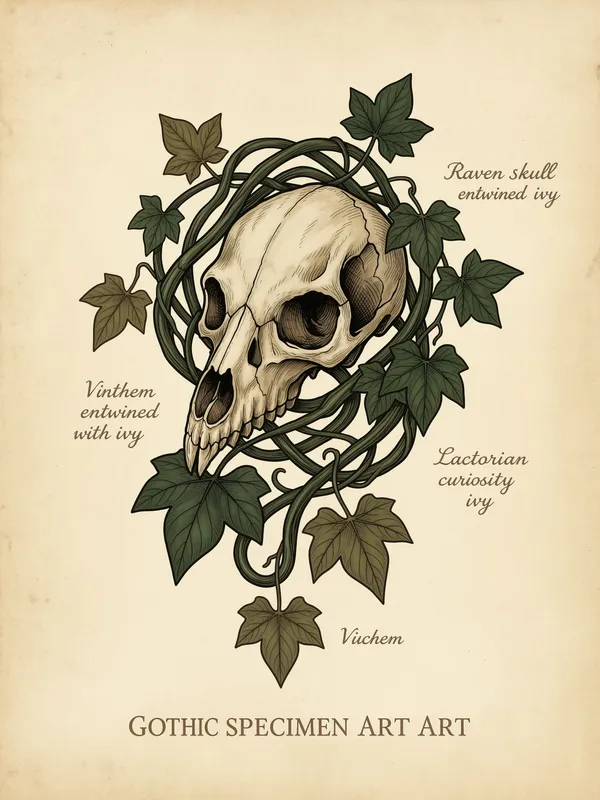
Raven skull entwined with ivy creates a dark academia gothic composition inspired by Victorian curiosity cabinets. Fine ink linework, handwritten Latin labels, and sepia and deep green tones give the Enhanced Matte Paper (189 g/m²) a weathered, botanical feel. Display this art print in a study or library, or give it as a thoughtful gift for lovers of gothic natural history.
The eye meets a pale raven skull set against curling ivy, its hollow sockets and narrow beak forming the sharp focal point of the composition. Leaves wind around the bone in looping stems, creating a balance between the skull’s hard, angular structure and the plant’s softer, irregular shapes. Fine black ink lines define every contour: feather traces, teeth, leaf veins, stems, and small changes in shadow are rendered with the careful precision of a specimen plate. Sepia washes warm the background and bone, while deep green gathers in the ivy, giving the image a restrained palette of aged brown, moss, and near-black. Handwritten Latin annotations sit among the forms, adding the visual character of a page removed from a natural-history folio. The overall surface feels quiet and weathered rather than glossy, with enough open space around the central forms to let the details remain legible from across a room.
The style belongs to the tradition of nineteenth-century Victorian botanical and zoological illustration, when plants, animals, fossils, and other natural objects were arranged for close study as well as display. Its clearest marker is the combination of precise observational drawing and handwritten classification: the skull and ivy are treated as collected subjects, while the Latin labels suggest a cabinet, folio, or scholar’s working notes. This gives the image a connection to the curiosity cabinet, where unusual specimens were grouped together to invite comparison and contemplation. It also suits the atmosphere of a literary study, where shelves of novels, old maps, glass jars, and wooden furniture can echo the print’s muted palette. Rather than presenting the raven as a simple symbol, the composition places bone, leaf, script, and linework on the same visual field, making it feel like an imagined page from a private archive of gothic natural history.
On a wall, the print works especially well above a writing desk, beside a bookcase, or in a reading corner with dark wood, aged brass, and deep green or charcoal upholstery. A narrow black frame will reinforce the ink drawing and the raven’s silhouette; a warm wood frame can bring out the sepia tones and make the piece sit comfortably among books and botanical objects. Hang it where the surrounding colours are quiet enough for the ivy and Latin notes to remain visible, such as against cream, parchment, muted olive, slate, or brown paint. Soft, indirect daylight will reveal the fine lines without flattening the darker areas, while a warm table lamp or shaded wall light will draw attention to the skull’s contours and the layered leaves after dusk. In a library, office, bedroom, or study, it can stand alone as a focused specimen image or join other botanical and anatomical prints to form a considered gallery wall. It also makes a fitting gift for someone drawn to gothic literature, Victorian imagery, ravens, or the visual language of collected natural-history studies.
“A raven skull wrapped in ivy channels dark academia's quiet romance, lending scholarly atmosphere to any wall it inhabits.”
- SubjectRaven skull entwined with creeping ivy, candle-lit and quietly macabre
- Palette & lightDeep charcoals and forest greens warmed by a soft candlelight glow
- CompositionCentered skull motif with ivy tendrils radiating outward in balanced symmetry
- Where it fitsReading nook, study, or office for those drawn to dark academia
| Material | Enhanced Matte Paper (189 g/m²) |
| Digital printing | |
| Care | Frame or mount out of direct sunlight; wipe gently with a dry, soft cloth. |
| Shipping | Made to order — ships in 2–5 business days |