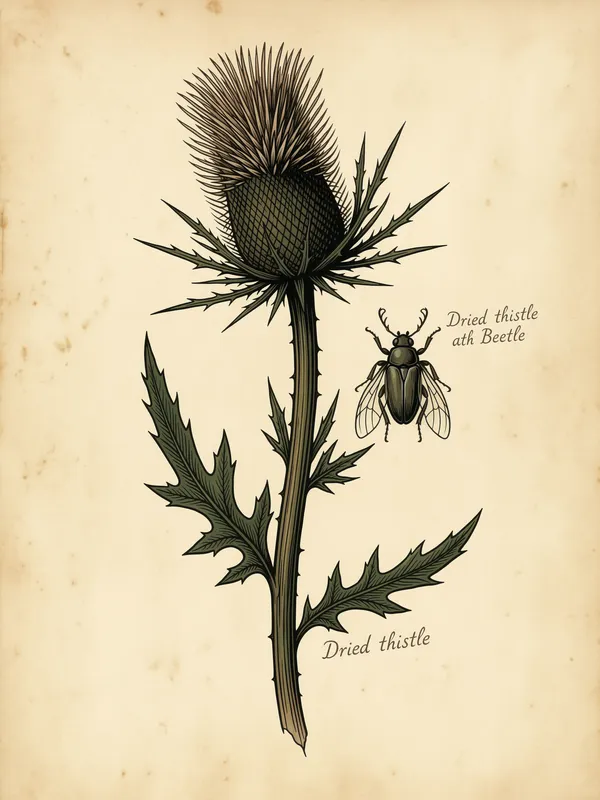
Dried Thistle and Pinned Beetle Art Print, dark academia decor, Victorian botanical wall art, gift for nature lovers
A dried thistle and pinned beetle emerge in fine ink linework, framed by handwritten Latin labels on an aged cream paper ground. Printed on Enhanced Matte Paper (189 g/m²), the sepia and deep green palette gives this gothic botanical art print a moody Victorian curiosity-cabinet presence for a study, reading nook, or thoughtful gift.
The thistle begins as a plant of open ground: a tough, upright botanical form with narrow leaves, jagged edges, and a rounded flower head built from many fine, pointed bracts. Its structure has long made it a natural subject for botanical observation, where the shape of a stem, the pattern of a leaf, and the texture of a dried bloom can be recorded as carefully as a portrait. Beside it, the beetle belongs to another branch of natural study, its hard wing cases, segmented body, and small articulated legs offering a compact example of the variety found in the natural world. Together, the plant and insect recall the specimen displays and handwritten classifications associated with Victorian curiosity cabinets: objects gathered from fields, gardens, and woodland margins, then arranged for close inspection. The Latin wording around them gives the composition the feeling of a page removed from a naturalist’s working collection, where identification and visual detail share the same space.
This artwork treats both subjects as quiet, carefully preserved forms rather than bright garden illustrations. Fine sepia ink traces the thistle’s stem, spines, leaves, and dry flower head, while the beetle sits in profile with its shell and legs clearly defined. The two forms emerge against an aged cream ground, leaving enough open space for the handwritten Latin labels to remain part of the image instead of functioning as a separate caption. Deep green accents settle into the botanical details, while brown, charcoal, and muted black lines give the composition the restrained colour of an old study plate. The contrast between the organic thistle and the compact geometric body of the beetle creates a balanced arrangement: one rises vertically with irregular edges, the other rests as a small, dense shape nearby. Printed as an art print on matte paper, it has the appearance of a collected page, with a subdued surface and a palette suited to wood, brass, leather, and dark-painted frames.
This print will speak to anyone drawn to field guides, herbarium sheets, entomology, and the atmosphere of a Victorian study. A reader who keeps botanical reference books beside an armchair may appreciate the way the handwritten labels turn a simple wall image into something that invites closer looking. A collector of beetle illustrations, pressed flowers, antique maps, or natural-history objects will recognise its specimen-like arrangement and measured detail. It can sit above a writing desk, beside a bookcase, in a reading nook, or on a gallery wall with other botanical and scientific prints. The dark green and sepia palette works with walnut, oak, black, cream, and aged metal, while the cream background keeps the image distinct against a deep blue, charcoal, forest-green, or warm white wall. For a nature lover, gardener, entomology enthusiast, or admirer of dark academia interiors, the subject offers a thoughtful connection to the living world without becoming decorative in a bright or overly floral way. It is a considered choice for someone who would rather hang a thistle and beetle than a generic pattern: two modest specimens, set down in ink, with the quiet presence of a page from a personal cabinet of curiosities.
“A muted, scholarly specimen study that turns quiet curiosity into considered wall poetry.”
- SubjectA dried thistle paired with a pinned beetle, rendered as an antique natural history plate.
- Palette & lightMuted purples and dusty greens set against a deep, shadowy ground with soft even illumination.
- CompositionCentered, tightly cropped specimen arrangement with measured negative space lending a museum-label calm.
- Where it fitsA reading nook, a biologist's study, or a quiet home office that prizes careful craft.
| Material | Enhanced Matte Paper (189 g/m²) |
| Digital printing | |
| Care | Frame or mount out of direct sunlight; wipe gently with a dry, soft cloth. |
| Shipping | Made to order — ships in 2–5 business days |